Showing posts with label etutorial. Show all posts

Wednesday, 15 August 2012

physics


Physics
The science of nature. Physics is that branch of science which treats of laws and properties of matter and force acting upon it. The department of natural science (physics) which treat the causes (electricity, heat, light, magnetism) that modify the general properties of body; natural philosophy.
Another definition
Physics is an important branch of science which offer the study of matter and energy along with the interaction between them
According to Wikipedia
Physics is a natural science that involves the study of matter and its motion through space and time, along with related concepts such as energy and force.


Saturday, 24 March 2012

Introduction to Simple Ciruits

hello friends!
how are you ? i hope fine 
well now today i will tell you about some basic circuits such as
  • open circuit
  • short circuit
  • series circuit
  • parallel circuits
these are the basic introductory circuits which you need to know about these circuits first and then you will be able to construct or understand the higher circuits. in these circuits only the electron flow direction which is very simple. 
now i will tell you about the

open circuit

                         As the name suggest that open circuit have such a circuit which have opened. in other words we have to say that they have opened and can not complete the path of electron to flow. now i will show in the diagram below 


you will see that we make a circuit in which we connect the switch battery and a resistor when the switch is open no current flow through it because the switch disconnect the path of flow of electron. and the electron is static and voltage drop across the circuit is zero. you will see in the diagram 


yeah you will see that the voltage drop across the resistor is zero. because no current flow into it.


short circuit
                                   when we closed the switch the path of electrons is complete and current is flow through it you will see what happen when we short the circuit use only switch and battery


you have seen that when we short the circuits without connecting the resistance battery and switch is burnt because electron flow speed is very high and we have not controlled the electrons speed.
this is the reason when we short the two wires(positive wire and negative wire). the electron burn the battery(source) due to its high speed. that's why we are not short the negative and positive wire.

series circuit
                          In the series circuit we see that all the electrons flow in series it is not divide. In other words we say that we have a pipe and water (electrons) are flow through it. the force to move the water (voltage) is divide in the series circuit. now you have seen that electrons remain the same and voltage is divide into the series circuit. the below diagram clear your concepts of series circuit.


you will see that we have 9 volt battery source and we connected bulb and resistor the voltage drop across the resistor is 4.5 and voltage drop across the bulb is 4.5. current flowing through it is 0.45 ampere. you will see in series ciruit current is not divided but the voltages across the bulb and resistor is divided. 

Parallel Circuit
                                      In the parallel circuit the current is divide and voltages remain the same. for concepts in the parallel circuits we have a pipe which is subdivided and water have multiple paths to flow through it.
the force called voltage remains the same in parallel circuits but the current is divided you will see in the simulation diagrams


You will see that in parallel circuits first the current is 1.80 amperes after division current is 0.90 amperes on both sides but the voltages across the two paths remain the same 

 after reading this article we will come on a point that in series circuits current is same and voltage divides and in parallel circuits voltage remains the same and current divides.


hope you will like my article. if you have any confusion regarding this article please comment. 

Thank you  for reading my article

Friday, 23 March 2012

Importance Of Resistance

                              As you know resistance is the oppostion of charge. Now my question is why we use the resistance ?
What happen when we not use the resistance ?
These are the question i will tell you in this article. Now i am talking in ideal condition when we have a source(ac or dc) such as battery for dc are connected both terminals with wire having zero resistance. then are short circuited and the battery will be burn. you think why you believe in my words. yeah are not believe on me but beleive on the simulation you will find out the results like this.


you will see that when wires are connected to battery having no resistance unlimited amount of electrons flow through it and they have blast and battery is finished.
now i will show you when we connected the resistor what is the behaviour of the circuit. Lets see


aaahhh you have been seen that the battery source is not blast afer connecting the resistor electrons move smothly and and control the speed of electrons.
AS i will tell you that the current flow is like water flow as water flow easier path in which no resistor accur in the same way current/electron follow the path in which no resistance found when we connected the two path such that one path have a resistor and another have not. then what is the behaviour of current. and how it effect on battery see it in the diagram below


ooohhh you will see electrons follow the easier path and have shorted. the battery connected to it is burnt. hope you will understand what i want to say my article that resis is very important to control the current and voltages in my future post i will tell you current divider voltage divider but now you will see that when we connect resistor in both paths then what happen to it.


you will again see when we connected some resistance in the path of electron they force called voltage drop across the resistors and there is no effect in batery the battery is smoothly discharge.
i hope you understand my article if you have any problem related this article the please comment i will reply back to you as early as possible.
thank for reading my article ......


What is a breadboard?


A breadboard is used to build and test circuits quickly before finalizing any circuit design. The breadboard has many holes into which circuit components like ICs and resistors can be inserted. A typical breadboard is shown below:


The bread board has strips of metal which run underneath the board and connect the holes on the top of the board. The metal strips are laid out as shown below. Note that the top and bottom rows of holes are connected horizontally while the remaining holes are connected vertically.


To use the bread board, the legs of components are placed in the holes. Each set of holes connected by a metal strip underneath forms a
node. A node is a point in a circuit where two components are connected. Connections between different components are formed by putting their legs in a common node.The long top and bottom row of holes are usually used for power supply connections. The
rest of the circuit is built by placing components and connecting them together with jumper wires. ICs are placed in the middle of the board so that half of the legs are on one side of the middle line and half on the other. A completed circuit might look like the following.


Breadboarding tips:

                                        It is important to breadboard a circuit neatly and systematically, so that one can debug it and get it running easily and quickly. It also helps when someone else needs to understand and inspect the circuit. Here are some tips:

1. Always use the side-lines for power supply connections. Power the chips from the side-lines and not directly from the power supply.

2. Use black wires for ground connections (0V), and red for other power connections.

3. Keep the jumper wires on the board flat, so that the board does not look cluttered.

4. Route jumper wires around the chips and not over the chips. This makes changing the chips when needed easier.

5. You could trim the legs of components like resistors, transistors and LEDs, so that

they fit in snugly and do not get pulled out by accident.

Thursday, 22 March 2012

Basics of measuring resistance


                                                                        When measuring resistance, all musltimeters use exactly the same principle whether they are analogue multimeters or digital multimeters. In fact other forms of test equipment that measure resistance also use the same basic principle.
The basic idea is that the multimeter places a voltage at the two probes and this will cause a current to flow in the item for which the resistance is being measured. By measuring the resistance it is possible to determine the resistance between the two probes of the multimeter, or other item of test equipment.
It is very simple to measure the resistance of any resistor. you just connect the probes with the resistors in this way that the resistor is placed between the probes and take the reading. we have to measure the resistance with two kind of meters like analogue meter or digital multimeters.

For example if you wanna determine the resistance of wire you will connect the two probes with wire as shown in the diagram and the meter give the resistance of wire this very simple example to measure the resistance of conductor/resistor.
i hope you will have a rough idea about the measuring the values of resistance
thank you for reading my article bye

Monday, 12 March 2012

Resistance


The electrical resistance of an electrical element is the opposition to the passage of an electric current through that element. resistor is actually the conductor(in which the electric current flow is called conductor). there is free electron present in the conductor when the electron in the current passed into the conductor the electron present into the conductor which is freely move is strike and reduce the speed of electrons and in this way resistor drop the current speed.
The si unit of resistance is called ohm Ω.
                                                         if we increase the temperature of conductor. the free electron in the conductor move rapidly and the chance of collision increases is also increase and resistance value is large. if we decrease the temperature resistance value is also decreased. this is the simpler concept of resistance in otherwords we can says that resistance is the material which decrease the speed of current. the speed of current is due to the voltage (electromotive force) the resistor drop the voltage.
                                                         the difference between voltage and electromotive force is that when the voltage source is not connected to the circuit the force appear to its terminal is called electromotive force. when the source connected in the circuit is called voltage  

Saturday, 10 March 2012

Voltage

 is also called electromotive force(force to drive the current).it is a quantitative expression of the potential difference in charge between two points in an electrical field. The greater the voltage, the greater the flow of electrical current through a conducting or semiconducting medium for a given resistance to the flow. Voltage is symbolized by an uppercase italic letter V or E. The standard unit is the volt, symbolized by a non-italic uppercase letter V. One volt will drive one coulamb (6.24 x 10¹⁸) charge carriers, such as electrons, through a resistor.
                           In other words that voltage is a force which drive the
current. suppose that the current flow is like the water flow and the voltage is the force which drive the current/water. current always flow when it have some force(voltage). let us consider that we have two tanks of water having the equal/same water having hole in the tank and connected through pipe mean two tank having same water level connected through pipe. the water in the tank give no response and have the same water level. if we place one tank to a higher position and other in lower such as different potential difference. you will see that the water from higher potential/position flow to the lower potential/position. in the same way as a water current will flow only from higher potential to the lower potential. when the current in the zero potential difference(difference between two levels/points) no current flow through it.

Hope you have some idea about the volage thank you for reading my article

Current


Current

The rate of flow of charge with respect to time is called current

It is donated by I

The si unit of current is ampere (A)

Mathematically

Mathematically it is denoted by

I=Q/t

Q= charge

T=time

Dear friends for understanding the current you will think current flow is like the water flow we follow in all our concepts that current is like the water. Actually the current is the flow of charges and in the medium like wires metal which are inside the insulating cover allow the charge to flow through it and insulating cover is like a pipe which does not allow water to flow through it.


Example

The charge passed in the conductor is 10c in 5 sec. find the current in the conductor ?

Solution

As we know that

I=Q/t

I=10/5

I=2 A(ampere)


Thank you for reading my article.


Friday, 9 March 2012

Structure of Matter


structure of matter


Here i will give you the basic concept of structure of matter. the structure of matter is very simple to explain firstly you will see the diagram of structure of matter. you see that the matter is certain substance when we see its structure we will see its basic particles like atoms. All the matters is composed of atoms .
what is atom ?
this is a question which arise in everyones mind now I will tell you that the atom is the smallest unit of matters which have three basic particles called electron proton and neutron (other than these there also many sub particles but these three are the fundamental component of atom ).
Nucleus(collection of proton and nuetron) lies in the atom is in center of atom and electron is revolving around the nucleus in the same way as our earth revolving around the sun electron.


As we see in the diagram the centeral element of atom which consist of positively charge proton and have the neutrally charge neutron or we say that neutron have no charge in it.
neutron have no charge in it so it is not show in the diagram the positivly charge proton and negatively charge electron attract together and make the net charge is zero in an atom


LIKE CHARGE REPEL EACH OTHER AND UNLIKE CHARGE ATTRACT EACH OTHER
 
 
This is about the complete behavior of charges that the charges I will tell you in the 3 simple easy and interesting points
 
 
ELECTRONNEGATIVE CHARGE (-)
 
 
PROTON POSITIVE CHARGE(+)
 
 
NEUTRONNO CHARGE(NEUTRAL)
 

             If we place two electron closed to each other they are repel each other
    • If we place two proton closed to each other they repel each other
    • If we place one electron and one proton closed to each other they are attract each other
Dear friends i am not going in detail for the structure of matter i give you the basic overview of the structure of matter as my blogs name suggest it is all about the electronics so in the further article step by step i will going on the topics and techniques of electronics theorems laws and study the basic components their behaviour and many more         if you like my articles please comment and thank you for reading my article I try my best to improve my articles please give me your suggestion thank you again

Thursday, 8 March 2012

Electricity


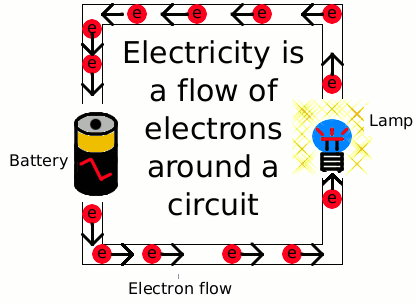
   It is the form of energy which we obtain from the existance of charge particles such as electrons,protons either statically as an accumulation of charge or dynamically as a current


                                           first of all i would like to start from the basics concepts what is energy when he produced ? the answer of this question is very quite simple that when we charge any particle it have some energy for example if we will rubbed our both hands we feel heat in it the reason is simple when we rubbed the particle it have store charge in the same way when we have the particle like electron or proton which have excited in the have also stored charge in it. we define the electricity in the same way that the collection/accumulation of charge particles either they have static condition or dynamic condition like current. in simple words we have to say that the electricity is the condition of feeling excitement /thrilling.
                                        you are lucky to read the word electricity because some of underdeveloping countries public says to government to say that you use old fashioned lamp of oil because from now no electricity have to given to anyone we remove our electricity wires hehehehehe its just a joke subscribe this blog to read all articles about the electronics. please give your comments thank you bye

Twitter Delicious Facebook Digg Stumbleupon Favorites More

 
Design by Free WordPress Themes | Bloggerized by Lasantha - Premium Blogger Themes | Bluehost Review